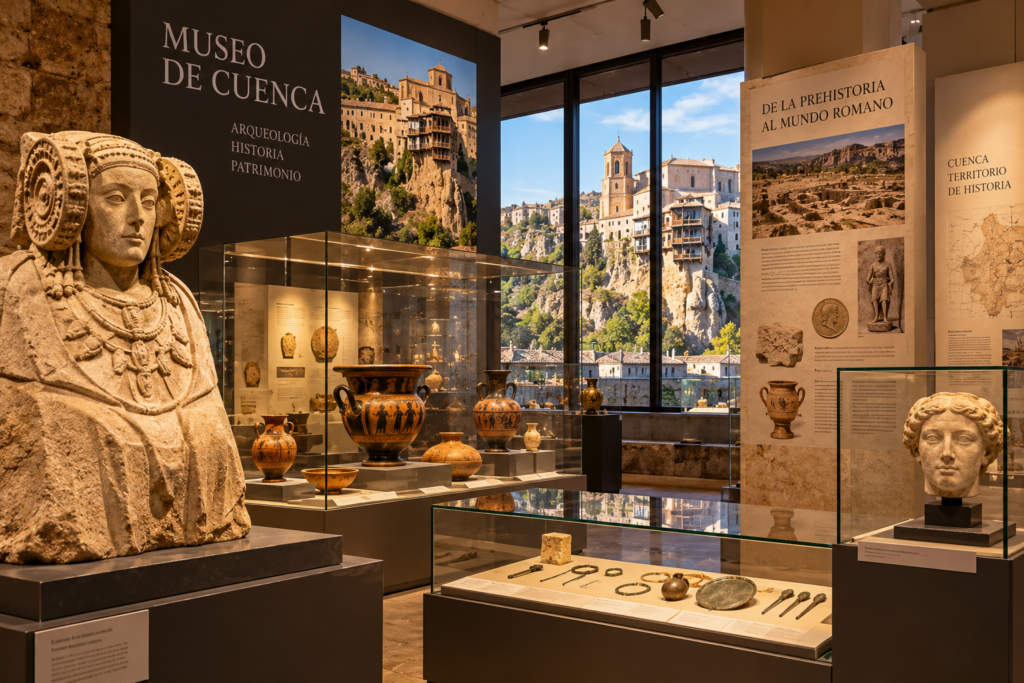
Cuenca · History · Archaeology
Cuenca Museum: History, Archaeology and Cultural Heritage
Explore archaeological collections, ancient civilisations and the rich history that helps us understand the past of Cuenca and its province.
Cuenca is known for its Hanging Houses, its historic urban landscape and its close connection with art and culture. However, to gain a deeper understanding of its past, it is also worth discovering the places that preserve and explain the remains of the civilisations that once inhabited this region.
Cuenca Museum is an important reference point for exploring the province’s history through its archaeological collections. Its objects reveal different periods of the past, from the earliest human societies to more recent historical eras, showing how ways of life, beliefs and economic activities evolved over time.
Visiting an archaeological museum is about much more than looking at ancient objects. Each artefact can provide information about the people who made it, the places where they lived and their relationship with the surrounding environment. In this way, the museum transforms material remains into a story about Cuenca’s history.
The History of Cuenca Museum
Cuenca Museum is dedicated to preserving, studying and displaying the historical and archaeological heritage of the province. Its role is essential in bringing together materials from different archaeological sites and making the region’s historical development accessible to the public.
The province of Cuenca has a remarkable archaeological heritage. Over the centuries, different communities settled in its mountains, valleys and plains, leaving traces of their everyday activities, social organisation and cultural traditions.
Objects recovered through excavations and other research projects help reconstruct aspects of these societies. Pottery, tools, coins, sculptures and other material remains provide clues about how settlements developed and how communities changed over time.
The museum therefore performs two important functions: preserving objects of historical value and helping visitors understand them through accessible displays and interpretation.
A Journey Through the Archaeology of Cuenca
The archaeological collections offer a broad view of the province’s past. Through objects from different periods, visitors can explore changes in manufacturing techniques, settlement patterns and relationships between human communities.
The Earliest Human Societies
The oldest remains provide insight into the earliest human occupation of the region. Tools and other archaeological materials can reveal how people obtained food, used natural resources and adapted to different landscapes.
Studying these remains helps us understand that Cuenca’s history began long before the formation of its present-day towns and cities. The region was home to different ways of life that evolved as environmental conditions and technical knowledge changed.
The Metal Ages and Pre-Roman Societies
As new manufacturing techniques developed, communities adopted new tools, decorative objects and increasingly complex forms of social organisation. Metalworking, commercial exchanges and the evolution of settlements gradually transformed everyday life.
Archaeological materials make it possible to study these changes and learn more about the communities that inhabited the region before Roman expansion. The objects also provide clues about their contacts with other territories and the movement of goods and ideas.
The Roman Presence in the Province
The Roman period is one of the most important chapters in Cuenca’s ancient history. The province preserves significant remains connected with Roman towns, communication routes, economic activities and systems of social organisation.
Among the most notable archaeological sites in the region are Segóbriga, Valeria and Ercávica. These locations provide insight into Roman urban development and help explain the importance of certain population centres during Antiquity.
Roman coins, pottery, sculptures and other objects help researchers interpret the economic, social and cultural life of these communities. Each artefact becomes more meaningful when considered alongside its archaeological context and the structures found nearby.
The Middle Ages and Later Historical Periods
Cuenca’s history continued to evolve throughout the Middle Ages and the centuries that followed. Political changes, cultural relationships and the development of new urban centres all left their mark on the region.
Material remains from these periods complete the picture of a province shaped by different traditions and ways of life. Their study helps explain how communities adapted existing spaces and developed new expressions of cultural identity.
The Collections and Their Historical Value
One of the main contributions of an archaeological museum is bringing together objects that might otherwise appear to be isolated fragments of the past. Organising the collections makes it possible to connect artefacts with historical periods, places of origin and specific human activities.
Different types of material help visitors interpret the archaeological past, including:
- Pottery: provides information about vessel production, food, storage practices and decorative techniques.
- Tools and utensils: help researchers understand productive activities and the technical solutions used in different periods.
- Coins: offer evidence about economic activity, trade and aspects of monetary circulation.
- Sculptures and decorative objects: reveal artistic expression, beliefs and aesthetic preferences in different societies.
- Everyday objects: bring visitors closer to the customs, needs and daily activities of people in the past.
Interpreting these materials depends on archaeological research and the information available about their origins. This is why preserving and documenting every object is essential to maintaining its scientific and historical value.
Cuenca and Its Artistic and Cultural Heritage
Cuenca’s heritage extends far beyond archaeology. The city and its province bring together historic architecture, popular traditions, natural landscapes and artistic expressions that reflect different stages of their development.
Cuenca’s old town, set among dramatic gorges and rocky elevations, offers a distinctive environment where historic buildings, narrow streets and scenic viewpoints coexist. The famous Hanging Houses have become one of the city’s most recognisable symbols.
This wealth of heritage creates connections between ancient history and the artistic expressions of later periods. Understanding the past makes it easier to interpret the monuments, artworks and traditions that form part of the region’s identity.
Visitors interested in exploring the relationship between artistic creation, heritage and visual interpretation can also discover Istorik Gallery, offering another perspective on art and culture.
The Importance of Preserving Archaeological Heritage
Archaeological remains are material testimonies of societies that no longer exist. Preserving them makes it possible to study the past using scientific methods and pass research findings on to future generations.
Protecting this heritage requires specialised care. Materials can deteriorate because of humidity, light, temperature changes or inappropriate handling. Museums therefore apply conservation and documentation standards suited to the characteristics of each object.
It is equally important to protect archaeological sites and respect their original context. An object separated from information about where it was discovered may lose part of its historical value, since the location and circumstances of its discovery provide essential evidence for interpretation.
Museums contribute to this work through research, exhibitions and educational activities. Their work ensures that heritage is not reserved exclusively for specialists but can be discovered and understood by the wider public.
How to Plan a Visit to Cuenca Museum
Planning your visit in advance can help you make the most of the experience. Whether you are discovering archaeology for the first time or have a particular interest in ancient history, it is worth taking time to examine the objects and read the information provided alongside them.
- Check opening hours: Confirm opening times, possible closures and admission conditions before travelling.
- Explore the exhibitions: Find out which collections and displays are available during your visit.
- Take time with the objects: Observe the materials, manufacturing techniques and historical explanations accompanying the artefacts.
- Combine culture and heritage: Complete your experience with a walk through the old town and other historic areas of Cuenca.
- Respect conservation rules: Follow instructions regarding photography, safety distances and contact with displayed objects.
The availability of galleries, exhibitions and visitor services may change. Before planning your visit, it is advisable to consult the museum’s official information to check current arrangements.
A Cultural Experience for Different Audiences
Cuenca Museum can appeal to a wide range of visitors. History enthusiasts have the opportunity to explore the development of ancient societies, while families and students can discover archaeology through tangible objects and visual examples.
For first-time visitors to the city, the museum offers a broader perspective beyond the best-known monuments. Its historical approach helps explain how the heritage we see today is the result of processes that unfolded over many centuries.
A visit can also spark curiosity about the province’s archaeological sites and the methods used to investigate the past. From excavation to conservation and exhibition, archaeological work combines observation, analysis and interpretation.
This approach makes the museum a place for learning and cultural outreach, where every object offers an opportunity to ask questions and discover new connections with history.
Why Cuenca Museum Is Worth Discovering
Cuenca Museum offers a way to explore the province’s history through the material evidence that has survived to the present day. Its collections help explain the diversity of the societies that inhabited the region and the changes that transformed their ways of life.
Its importance goes beyond displaying ancient objects. The museum helps preserve historical memory, share archaeological knowledge and bring the heritage of Cuenca closer to people who want to understand the region’s cultural identity.
Including this visit in a wider tour of the city makes it possible to combine archaeology, architecture and historic landscapes. It is an excellent way to discover Cuenca from a broader perspective and appreciate how its past remains visible in the heritage it preserves today.
Frequently Asked Questions
What can you see at Cuenca Museum?
The museum preserves and displays collections related to the history and archaeology of the province, allowing visitors to explore different periods of the past through historical objects and materials.
Why is archaeology important in Cuenca?
The province contains significant remains from different periods, including Roman sites such as Segóbriga, Valeria and Ercávica. These discoveries help explain the historical development of the region.
Is the museum suitable for students?
Yes. Archaeological collections can be valuable educational resources for learning about ancient societies, their tools, customs and historical development.
Can you combine a museum visit with other attractions in Cuenca?
Yes. The experience can be complemented by exploring the old town, the area around the Hanging Houses and other places of historical and cultural interest.
Where can you check the museum’s opening hours?
The best option is to consult the museum’s official channels before visiting, as opening hours, closures and admission conditions may change.